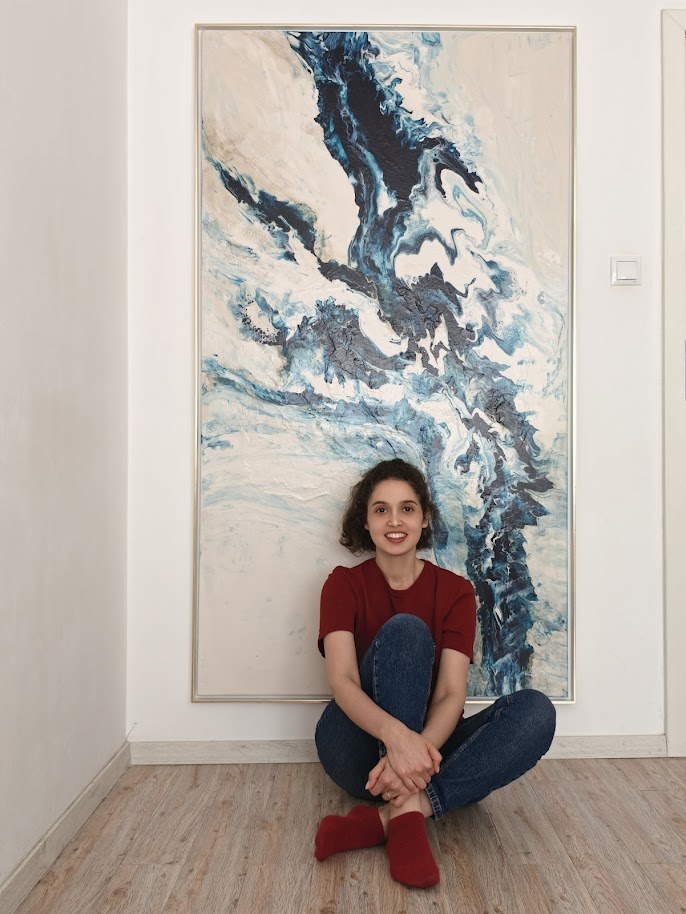
Where Light Meets Space: My Conversation with GRADAT

There is a traffic light near our home in Sofia where I always look up. On autumn evenings Vitosha sits under a dark grey cloud, and beneath it runs a thin line of orange, sometimes ochre. The light turns green, the cars move on, and I carry that line with me. It has found its way into many of my paintings, though you will never see it drawn literally.
I talked about that line, and about much more, with Petya Ralcheva for GRADAT. We met in a small café, and the conversation felt like one between friends who always have something to tell each other. The interview was published on 26 September 2026 in the magazine's Art&People section under the title "The Intersection of Light and Space". These are the threads I keep returning to since.
Architecture builds, art sets free
As a child I often walked with my father past the Institute of Fine Arts in Tunis. I watched the students with their folders and drawing tubes and told myself that one day I would be there. My father hoped I would study architecture. I insisted on the Institute, because to me it meant freedom. I graduated in interior architecture at the Institut Supérieur des Beaux-Arts de Tunis, and in the end I found both.
That is where I understood that space and image speak to each other. A painting never exists on its own. It lives in a room, in a certain light, beside one particular wall. The architectural precision I learned sits underneath every work I make. The difference is simple: architecture builds, and art sets free.
It is also why a painting of mine should never feel heavy, however large it is and however much paint it carries. Balance is something you feel rather than explain, like a building you walk into and suddenly breathe differently.

Night, and the morning after
I paint in the evening, when it is dark. Colours behave differently then, and so do I. My favourite moment comes the next morning, when I see the canvas in daylight with new eyes. Some paintings are finished in a single evening. Others wait for months, because something is still missing and I keep coming back to it. If a painting is not signed, it is not ready.
I work with the palette knife as much as with the brush. The knife gives relief, tension and movement, things a brush cannot give. Watercolour asks the opposite: the white of the paper is already there, and it is the light. I work around it, with it. On canvas, too, I rarely cover everything. I let it breathe.

A painting is a conversation
Before I paint a commission, I want to meet the people it is for, see the place where it will hang and how they live there. When you commission a work from me, you are not buying acrylic on canvas. You are commissioning a feeling, and inviting a small part of my world into a conversation with yours. The result should provoke, hold the eye and remain unmistakably yours.
This is also why I rarely accept "paint me something like this one". A painting is unique. It cannot be made again, not by me and not by anyone else. That is what prints are for: beautiful, but without the uniqueness of the original.
In the interview I also remembered one of my most unusual commissions. In Tunisia, during the week of my own wedding, an investor asked me for a painting for every room of a house that was still being built: around ten works. A Tunisian wedding lasts seven days. I slipped away between celebrations to paint, and delivered the last canvas the day before the ceremony. He told me it was exactly what he had imagined.

The handmade, and the silence
Petya asked whether artificial intelligence could devalue the talent and labour of people like me. I don't believe it can. I see people returning to the handmade and valuing it more, precisely because it is disappearing: upholstery, hand-painted wallpaper, sculpture, everything that carries the trace of someone's hands.
But if those who set the standards in art and design do not protect authorial, handmade work, it will die. Not because of AI. We will kill it with silence.
Art is work, and it should not be underestimated.
The next time you stand in front of a painting, in a gallery or in a friend's living room, look for the hand in it: the ridge left by a knife, a corner of canvas left bare on purpose, a line that was scraped back and painted again. Then ask what that painting would say in your own room.
Read the full interview (in Bulgarian) on GRADAT: The Intersection of Light and Space
My thanks to Petya Ralcheva and the GRADAT team for a conversation I will remember.
If you would like a painting made for your own space, you can tell me about it here.